Showing posts with label BPA 170 Finishing. Show all posts

Thursday, June 16, 2011

Verrine

Verrine is French for pretty glass. This essentially means a dessert that is built in a glass. When you do this you have to keep in mind layering and air bubbles that might form while layering. You also have to keep in mind that all the layers are going to be exposed. And to have the design play with the shape of the glass, something like a flower might flow on the inside of your glass if its a circle and has that organic shape to play with but might not work with the sharp edges of a square. The dessert usually has many components including, but does not have to include, a crunch layer to break up the space and also provide a different mouth feel.

Below is an example of a verrine that we did in class:

A play on a mojito: yields aproximately 14 verrines
Components:
Rum infused mousse: pâte à bomb method (adapted from Saus, 745)
100%, 35% Cream, 7 1/8 oz.
100%, 64% Couverture, 7 1/8 oz.
30% Egg yolks, 2 1/8 oz.
30% Sugar, 2 1/8 oz.
10% Water, 3/4 oz.
100%, 40% Cream,  7 1/8 oz.
80% Rum, 6 oz.

Rum Gelée:
8 oz. Rum
8 oz. Simple syrup
4 sheets gelatin*
*use approximately 3 oz. of gelatin per cup of liquid

Lime Mousse: anglaise method (adapted from Saus, 741)

27% Lime juice, 1 7/8 oz.
46% Sugar, split, 3 1/8 oz
33% Egg yolks, 2 1/4 oz.
26% Butter, 1 3/4 oz.
Lime Zest, 1 each
100% Whipped cream, 6 7/8 oz.

Mint Gelée: puree
4 oz. mint
6 oz. simple syrup
3 sheets gelatin

Entremet

Entremet traditionally a term that refers to a composed cake of a small size. This word also is used to described the dish that is served between courses at a fine dining establishment. In modern usage it sometimes is used to describe any mousse cake.

Other books that we looked at, aside from the Saus book were:
Stephane Galcier's Verrines et Petits - Gâteaux
Carole Bloom's Bite Sized Desserts
Flo Braker's The Art of Making Bit-Sized Desserts


Entremets usually have several layers of mousses in them. A review of what is in a mousse: base + stabilizer + lightener. Below are some flavour combinations that you can use for en entremet and then some examples of what we did.

Base: anglaise, ganache, puree, chocolate fortified with butter/hot water/cream/coffee/puree/liquors. (Chocolate needs to be fortified so that it doesn't seize with the temperature shock; so that it stabilizes.)
Stabilizer: gelatin, pate a bomb, Italian meringue, cocoa butter/mykreso (natural brand of cocoa butter), agar agar (vegan option)
Lightener: pate a bomb, Italian meringue, whip cream, common meringue, babayon (egg yolks + sugar + liquor heated over double boiler to nappé)


An unfinished entremet: chocolate fuietine base, joconde sponge, filled with chocolate mousse and raspberry mousse (mousses not shown in picture)

Sunday, June 12, 2011

Petits Four Glace

This is very much a bakeshop staple. Coming out of Europe where marzipan and pouring fondant is a common finishing for cakes, usually they are enrobed in marzipan like it is done here, but on a larger scale even.

Formula:
1/2 recipe Almond cake
8 oz. Marzipan, more if you want to use for decorations
12 oz. Poured fondant
2 oz. Jam
2 oz. Simple butter cream for garnishing


MOP:

  • Turn baked almond cake onto a parchment lined board. If you want to have take the caramelized crust off the cake to achieve a single colour through the cake then refrigerate the cake and gently brush off the caramelized layer after the cake has set.
  • Spread a very thin layer of jam on top of the almond cake.
  • Stack another layer of cake on top and press down gently, then spread another layer of jam.
  • Place the last last, third, layer of cake down and press down gently to help the layers adhere. Spread another thin, very thin, layer of jam across and chill or freeze to allow the layers to set up to prevent shifting when cutting.
  • Roll out marzipan to 1/16" on a very clean surface. The large amounts of sugar in the marzipan will pick up everything that is on your work bench and when the marzipan is so thin, it will show. Dust with confectioners sugar to aide in rolling out.
  • Place the marzipan over the top of the cake, as a top layer. You will cut away the edges so you do not need to drape it over the sides, just make sure it covers as much of the cake as possible.
  • Let the cake fuse together in the refrigerator or freezer.
  • Take the cake out and trim down the edges.
  • Cut the cake down to 1 1/2" x 1 1/2" squares (or proportionate sized circles, turn the cake upside down and cut with a circle cutter for cleaner circle cuts). It should be proportionally wide to high.
  • Re constitute pouring fondant, if it has set up. You can reconstitute it with simple syrup (or hot water) and you can test it for consistency like you do with your finger and ganache. Be aware that if you heat the fondant over 110°F then it will be in danger of cracking and of loosing the shine.
  • Place cake cubes (or circles) on glazing rack and enrobe the cake. Make sure you go slowly and get the fondant over the whole cake. It is less forgiving then ganache. You can colour the fondant when reconstituting it, just know that the colour goes a long way.
  • Tap the cooling rack to allow the fondant to roll down the sides of the cake in a smooth manner.
  • Lift the cakes off the cooling rack very carefully and transfer to a board to set up completely. 
  • You can pipe designs on top of the cakes at this time.

Sunday, June 5, 2011

French Macaroons

Adding egg whites to the almond mix
French macaroons are not at all like American macaroons. French macaroons are a meringue (Italian or Common) and almond based cookie comprised of cookie and fillings. It sometimes is also made with hazelnut flour instead of almond flour. It is a really sugary cookie but it is very nice, and popular, because it is a very stable cookie for colouring or flavouring or piping designs on. Common fillings for the cookie include: buttercream, icing, ganache, jam, paste + buttercream, or curd + buttercream. These cookies are probably very popular because of their versatility and ability to be adapted to different flavouring, fillings, and colours very easily. You can look up the French patisserie, Laudrée, or Pierre Herme. The chef Stéphan Glacier.
Whipped egg whites


Formula: yields approximately 40 macaroons
250 g Almond flour
250 g Powdered sugar
80 g Egg whites
225 g Sugar
60 g Water
80 g Egg whites


MOP:

  • Sift almond flour and powdered sugar.
  • Processes sifted almond flour and powdered sugar until combined and fine.
  • Sift processed flour and sugar once again.
  • Mix in with one portion of egg whites, using a bowl scraper, until it forms a thick, consistent paste. Set aside.
  • Cook sugar to soft ball (240° F) and pour into whipped egg whites (make a hard meringue)
  • Fold meringue into almond base in sections: fold in a quarter, then another quarter, then the remaining half.
  • Pipe into dollar coin sized disks onto a silpat lined sheet pan, the same method of piping for cream puffs. You can pipe the macaroons pretty close together because they wont spread much.
  • Once the sheet pan has been filled, bang the sheet pan several times on each side to flatten the cookies and to get rid of any "tails" you might have gotten while piping.
  • If you want to reserve a portion of your batter and colour it, you can pipe designs on top that will blend in when baked. You can also finish cookies by sprinkling cocoa nibs or fuitine or other kind of desired chip garnish.
  • Let the macaroons sit out until a crust is formed (for a duller, rustic looking cookie) or bake immediately (for a more shiny finish).
  • Bake at 320° F until crisp and hard. The baked macaroon should not move at all when touched, but should spring to your touch slightly. Macaroons are best baked and filled the day before desired use, keep them refrigerated so the insides will absorb moisture over night.

Variation:
Flavouring or colouring can be added to the almond/sugar paste. For chocolate, sub 20% cocoa for powdered sugar. Fruit powder can be added, 15g raspberry powder was added here to give a slight taste difference but definite colour change. Powder is best added before egg is added so it can be sifted in for even distribution.
 

Wednesday, June 1, 2011

Tartlets

With fruit, you can either use a fresh fruit application or a cooked fruit method. The cooked fruit method is similar to that for a pie. You want to make sure that you are cutting the pieces smaller then you would for a pie though, as always appropriateness should rule all your decisions. And also as always there are many different ways you can garnish your tartlet shells after you get your various mis en place together. A few good rules to follow are:

  • Less is more
  • Think about rule of thirds
  • Think about where the fruit is leading your eyes
  • Moisture is more of a problem for the smaller shells, there is a less forgiving factor with the small size
  • Monotone colours still look really pleasing
  • Curds set up quite nicely, so you can with it more generously
  • Unbaked tarts will need to bake at a higher temperature then shells, 375°
  • If you are baking custards with a light consistency (short bake time) you will need to blind bake the shells before filling. Almond cream has a heavy consistency and longer bake time so you can bake this off without blind baking the shells.

Below are a few options for how to finish various shells:
  • Line tartlet shells with melted white chocolate or chocolate to act as a barrier against moisture
  • Line rim, dipped in apricot glaze and then a flour or coconut shreds (like for bouchee)
  • Meringue shells are a nice finish, make sure to not burn the crust when scorching the meringue. You want to have an equal meringue to curd ratio if you are finishing with meringue.
  • Can line shells with jam
  • Can top with streusel, or left over dough
  • Can pipe almond cream in as a filling or a top to the tartlet. Do not over fill as the almond cream will golden and expand slightly.
  • Cooked fruit, like the poached pears, do not need to be glazed because they wont oxidize after cooked. But you can glaze it if you want that aesthetic.


Unbaked and baked almond cream tartlet with cooked fruit rhubarb and orange filling. Extra crust is used as a garnish.


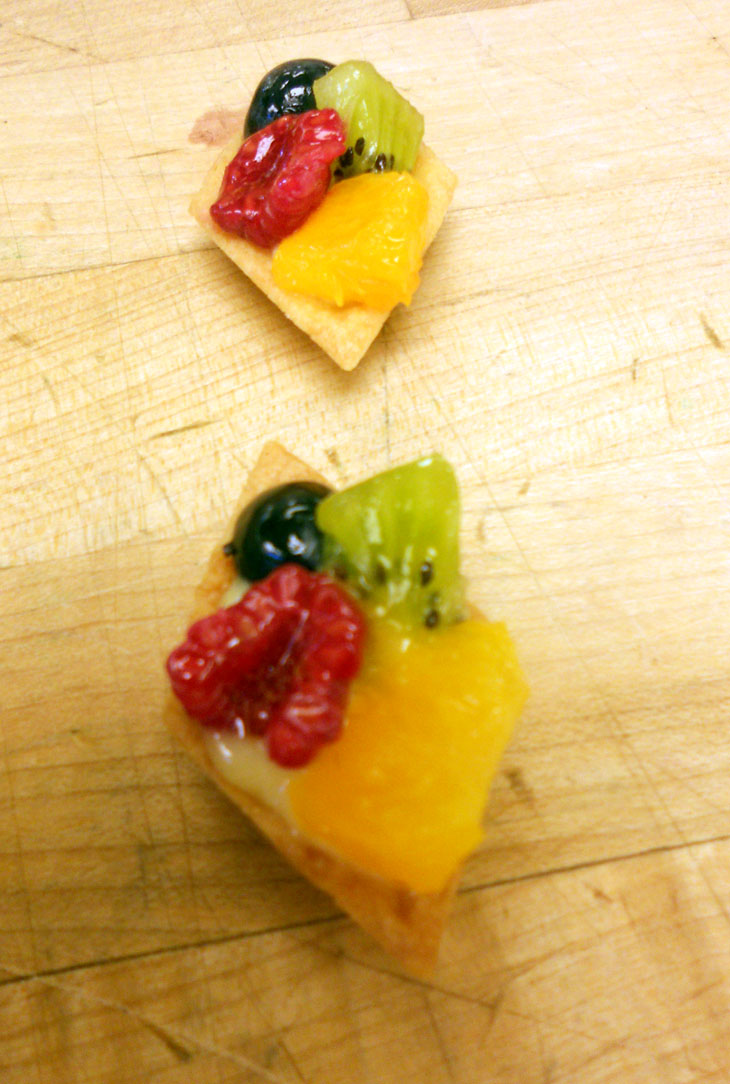
Different varieties of fresh fruit tartlets with pastry cream and or lemon curd fillings.


Lemon curd tartlets with a hidden layer of raspberry jam underneath which is hinted at with the fresh fruit garnish. Italian meringue garnishing which has been torched.


Poached pear, poached whole so that the colour did not seep through to the interior. When baked off as the garnish for a tart filled with almond cream it gives quite a nice rustic look while still adding a few hints of colour.

Tuesday, May 31, 2011

Fruit Tartlets

This is just a little description of different types of fruit tarts and tartlets that you can make in several different categories with common fillings and garnishes that are appropriate for that category.


Fresh Fruit Tartlets: always need to be glazed!
  • Trimmed fruit
  • Fruit salad
  • Flavoured or infused pastry cream
  • Crème diplomat
  • Candied herbs


Curd Tartlets: garnishes below...

  • Fresh fruit (glazed)
  • Italian meringue
  • Citrus chips (in small pieces!)
  • Candied flowers
  • Candied zest
  • Jam


Cooked Fruit Tartlets: with frangipane
  • Jam
  • Streusel
  • Almond cream

Custard Tartlets: filling is cooked in a blind baked crust, baked 300° until set. Sets much quicker then full custards. This is the category for a crème brûlée tartlet or pumpkin pie tartlet.


Monday, May 30, 2011

Turtle Tartlet

This is a elegant take on a simple homey dessert. The beauty of calling something turtle is that most Americans know exactly what they are eating even if its dressed up inside of a pink coloured sugar ball.


MOP:

  • Roast pecans in the oven until a slight aroma comes out from the nuts. Cool.
  • Pre bake tartlet shells with desired pastry dough.
  • Let cool before filling.
  • Fill bottom of the cooled shells sparingly with cooled roasted nuts.
  • Fill a squirt bottle with caramel sauce. Angle at 90° and squirt the caramel into the shell just under the rim.
  • Let the caramel sauce set.
  • Pour in ganache with a squirt bottle on top of the caramel sauce, revealing the caramel.
  • Let set up before garnishing.
  • Garnish the tartlet in the center with a caramelized or candied pecan.

Chocolate Crémeux Tartlet

This tartlet is a very delicate and rich little shell. It is definately good that it is a one or two bite-er because the crémeux is so rich, but in this make up that richness is accentuated the the gold leaf garnishing.


MOP:

  • Pre bake tartlet shells with desired pastry dough
  • Let cool before filling.
  • Melt chocolate and paint a thin layer of chocolate on the inside of the dough as a barrier against the moisture of the crémeux.
  • Re heat the crémeux over a double broiler if its solidified. You want the crémeux to be pourable, between 70° - 90°F.
  • Knock out air bubbles if any form.
  • Pipe in the crémeux starting at the corners and into the center to make it look uniform.
  • Let the crémeux set before garnishing.
  • Garnish with a small amount of gold leaf. Apply with a brush.

Choux make ups

Here are a few different things you can do with pâte a choux paste. When we think of pâte a choux, we usually think of eclairs filled with pastry cream and garnished with a nice shinny ganache with a little bit of white chocolate drizzled on top. And while that is pictured below, there are other things you can do with it.


Eclair (Fr. lightning bolt):
    Use an 804 tip
    Filled: pastry cream
    Glazed: ganache / stringing fondant / melted chocolate
    Variations: if you use a more savoury paste you can easily fill this shape with a savoury creamed item.


Cream Puffs:
   Use an 804 tip
   Filled: pastry cream, whipped cream
   Glazed: confectioners sugar, caramel
   Note: Croquembouche is a common usage for cream puffs that are dipped in caramel and then stacked on top of each other in a triangle shape.


Swans:
   Use an 826 tip, cone (or #4) tip
   Filled: whipped cream
   Glazed: confectioners sugar
   Note: this shape requires some assembly, but the cute factor that is achieved is quite worth the small amount of effort and time.


La Religieuse (Fr.  woman belonging to a religious order)
   Assembly: two different sized cream puffs, filled, the larger one dipped in chocolate and the smaller one dipped in stringing fondant. The assembly is supposed to mimic the image of a nun.
   Filled: pastry cream
   Glazed: ganach, stringing fondant


Paris-Brest: this shape was made to commemorate a bike race, it is supposed to look like a fast moving bicycle wheel.
     Use a 826 tip
     Filled: hazelnut pastry cream*
     Glazed: roasted almonds, confectioners sugar
*take about 2 T of hazelnut praline paste and 8 oz. of pastry cream and mix together. Add butter to the mixer until the mixture is about the consistency of buttercream. The butter allows the pastry cream to stabilize better since it is open to air and holds up without forming a crust.


Gâteaux St. Honoré:
This is a cake that we made in basic cake decorating. It was made in honor of the French patron saint for pastry chefs and bakers. It is a series of cream and cream puffs on top of a bed of puff pastry. And it resembles a crown when its finished.
    Filled:  crème chiboust ( pastry cream + gelatin + whipped cream)
    Glazed: caramel cage


Pête De Nonnes (Fr. nuns fart)
    Use an 804 tip
    MOP: pipe round oval shapes, about the size of a cream puff, into a fryer
    Glazed: confectioners sugar


Churros
    Use an 826 tip
    MOP: pipe star shaped sticks into the fryer
    Glazed: cinnamon and sugar


Gougère: 
    A savoury cream puff, usually has Gruyère cheese added to the choux pastry or is filled with the cheese.


Profiterole (choux à la crème)
   Use: 804 tip
   Filled:  ice cream
   Glazed: chocolate

Palmier

This is a traditional French dessert that resembles the American Elephant Ear. It is a very simple pastry to shape, and is a very yummy pastry to eat. It also holds up well to time and weather. So is a good stable choice for something like a sweet table. The basic shape could be modified to create a new pastry of your choosing, but it turns out like a little heart which is really rather nice.


Formula: yields approximately 30 palmier
12" wide strip of puff pastry
8 oz. granulated sugar
8 oz. confectioners sugar


MOP:

  • Sift together confectioners sugar and granulated sugar. Set aside.
  • Take a 12" wide section of puff pastry dough, the length does not really matter but determines how many pieces you can get.
  • Lay dough flat and dust heavily with sugar, rubbing the sugar in with your hands to create a velvety texture.
  • Flip the dough over to dust the other side in the same manner.
  • Flip the dough back over and dust if needed, sometimes the sugar falls off while changing sides. If the weather is very dry out, like in the winter, you can paint the dough sparingly with water to help the sugar mixture adhere to the dough. Trim down edges if you have not done so already.
  • Fold in dough, 1 1/2" on both sides.
  • Fold in again to the center, on both sides.
  • Fold dough over on it self at the center. You should have a thick booklet with several folds on both sides of the middle.
  • Cut off one end, and then cut across at 1/4" increments.
  • Lay each section flat on the parchment folds facing up. It should resemble a heart. Give ample amount of spacing between each section, this will allow for better air flow and expansion.
  • Bake at 400°F on a rack until the bottoms have caramelized. Flip each palmier over and bake for another 30 seconds to aide in colouring.

Thursday, May 26, 2011

Bouchee and Fruit Strips

This is a play on what we normally picture when the word fruit tart is said. This is essentially the same thing: a pastry dough base, a cream filling, fruit garnish, glaze on top. But in both of these make ups the base is puff pastry which gives this dessert a really interesting height and texture to the one or two bite dessert.


Formula: yields approximately 16-20 bouchee
1# puff pastry dough, approximately (you need a 8" x roughly 8" rectangle)
1# pastry cream
8 oz. whipped cream
Assorted fruit (and nuts)
Shavings: nut flour/coconut shreds/chocolate shavings, etc.
Apricot glaze


Bouchee
MOP:

  • Take rested puff pastry out from the refrigerator, cut an 8" strip from the dough. Sheet out the dough slightly.
  • Cut the dough in half to get two equal pieces.
  • Dock one half of the dough and set aside.
  • Use your 2" cutter to score circles across the sheet. Place the circles close together with minimal waste between each scored circle.
  • Use a 1/2" cutter to cut out a smaller circle in the center of each scored circle.
  • Egg wash the docked sheet. 
  • Gently lift the other sheet up and place it on top of the docked sheet.
  • Cut out the 2" circles. This will help to seal the two layers together. 
  • When the pieces are cut out then use the back of a pairing knife to flute (binds) the outside of the circle. This step not only textures the puff a little bit but it helps to hide any imperfections you might have gotten with the cutter. It also helps seal together both layers just a little bit more.
  • Egg wash the tops and place a clean sheet of parchment on top. Press down slightly so that the layer sticks. The parchment on top helps create an even vertical rise during baking.
  • Refrigerate to allow the gluten to relax before baking. This step is a luxury that helps the product but is not necessary, so there is no given time. Even 5 minutes would help the dough.
  • Bake at 375°F (375°-400°) until caramelized on the bottom.
  • Cool before filling.


Fruit Strips
MOP:
  • Cut off a 3" strip from the puff dough.
  • From this 3" strip cut one 2" strip and divide the rest in half (should get approximately two 1" strips).
  • Dock the 2" strip, egg wash.
  • Place each 1" strip on either side of the 2" strip. Creating a rail appearance.
  • Egg wash the top of the pastry. Place a parchment sheet on top and gently press down.
  • Refrigerate before baking.
  • Bake at 375°F until caramelized on the bottom.
  • Cool before filling.


Finishing: this is just one general method for filling both the bouchee and fruit strips.
  • Press down the center of the puffs slightly. Cut the fruit strip down into small rectangles roughly 1 1/2" x 2"
  • Dip the hallowed top side in apricot glaze, and immediately dip in desired shavings.
  • Set the pastry down so that the hallow is facing up. Fill this hallowed hole almost to the top with creme diplomat (1 pt pastry cream to 1 pt whipped cream)
  • Arrange Fruit on top of the creme, hiding it mostly.
  • Glaze fresh fruit.