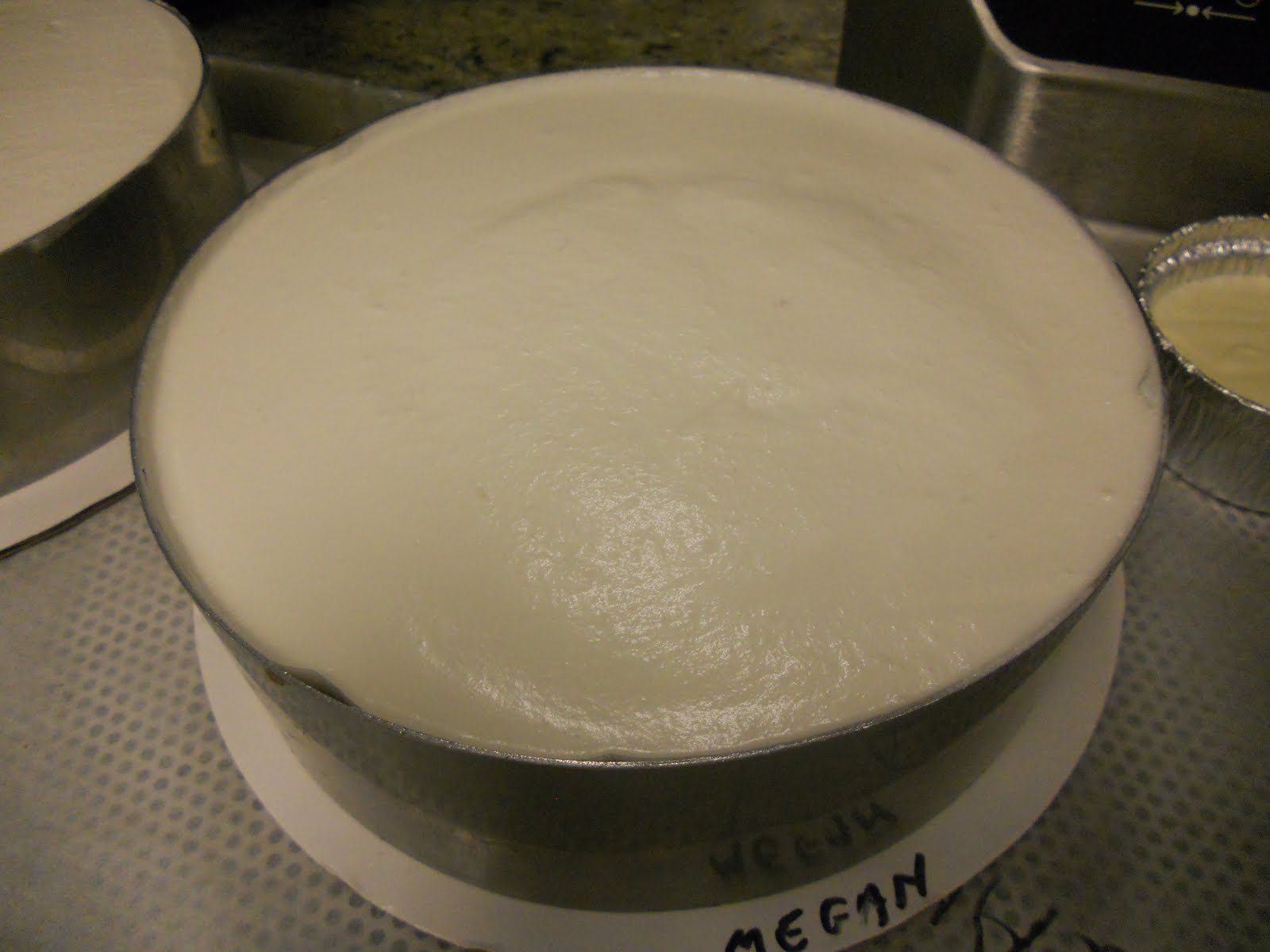
Formula:
Half of a baguette, or equivalent amounts of sweet breads
Roughly 20 oz. Crème Anglaise
Tools: bread pan, larger pan
MOP:
Slice bread into half slices or small cubes. Arrange the bread slices so they over lap in pan.
Pour the prepared crème anglaise over the bread in the pan. Let stand, refrigerated, for an hour so the bread fully absorbs the liquid.
Set the pan in a larger pan containing about 1 1/2 inch of water (have the water bath go up to half the height of the custard).
Place in a preheated oven: 300 °F deck oven/conduction oven, without rack, 0-10-10 setting with dampers open. 250°-275°F convection oven with a cover when baked. Approximately 40 min to 1 hour.
Let cool before serving. Serve either cold or at room temp.
I changed the title just a little bit because now I'm in my spring quarter. This quarter I'll be doing a lot more baking classes: Special Needs Baking, Breakfast Pastries, Advanced Baking and Pastries, and Art of Baking and Pastry Applications. I'll try to keep up with this in an orderly way, but pretty much you'll be getting a special need topic once a week and the other topics staggered through the next ten weeks.
Sunday, February 6, 2011
Crème Anglaise
Crème anglaise is a light vanilla flavored custard. It was the base for the Bavarian cream used in the strawberry cake, because it is essentially just an eggs, milk, and sugar custard. This is also going to be the same custard that is used for our bread pudding and the crème caramel recipe.
This formula, like most custards can be made by either doing a cold infusion method or a hot infusion method. This method of preparation describes how to do a hot infusion. To see the technique for a cold infusion see Crème Brûlée recipe. Reasons for using one method over another depends on speed and if you are using an acidic flavour or infusion for your custard. The acid, like lemon, will curdle the milk if it is heated up so for that kind of baked custard you would use a cold infusion.
Formula*: yields 12 portions, 5 oz each
16 oz. Eggs
8 oz. Sugar
0.08 oz. Salt (1/2 t)
0.5 oz. Vanilla Extract
2 lb 8 oz. Milk
Tools: saucepan, wooden spoon, whisk, stainless steel bowl, plastic wrap
*This formula is from Gisslen, Professional Baking Ed. 5, pg. 523
MOP: hot infusion
In a saucepan scald, or heat your milk.
In a separate bowl add your eggs, half of your sugar (4oz.), and salt. Whisk to combine.
When the milk starts to heat up add the other half of sugar to the milk. Stir to dissolve the sugar granules. When the sugar is dissolved temper the milk into the sugar (in approximately 3rds for this amount).
Cover the mixture with plastic, make sure the plastic is touching the custard. This step will help the air bubbles settle from the custard as it sets up. If you are using the custard for bread pudding you do not need to cover it before baking.
This formula, like most custards can be made by either doing a cold infusion method or a hot infusion method. This method of preparation describes how to do a hot infusion. To see the technique for a cold infusion see Crème Brûlée recipe. Reasons for using one method over another depends on speed and if you are using an acidic flavour or infusion for your custard. The acid, like lemon, will curdle the milk if it is heated up so for that kind of baked custard you would use a cold infusion.
Formula*: yields 12 portions, 5 oz each
16 oz. Eggs
8 oz. Sugar
0.08 oz. Salt (1/2 t)
0.5 oz. Vanilla Extract
2 lb 8 oz. Milk
Tools: saucepan, wooden spoon, whisk, stainless steel bowl, plastic wrap
*This formula is from Gisslen, Professional Baking Ed. 5, pg. 523
MOP: hot infusion
In a saucepan scald, or heat your milk.
In a separate bowl add your eggs, half of your sugar (4oz.), and salt. Whisk to combine.
When the milk starts to heat up add the other half of sugar to the milk. Stir to dissolve the sugar granules. When the sugar is dissolved temper the milk into the sugar (in approximately 3rds for this amount).
Cover the mixture with plastic, make sure the plastic is touching the custard. This step will help the air bubbles settle from the custard as it sets up. If you are using the custard for bread pudding you do not need to cover it before baking.
Saturday, February 5, 2011
Crème Brûlée
This crème brûlée formula honestly wasn't my favourite. And I'm also not a huge fan of crème brûlée... But non the less it does use a cold infusion technique that is quite simple to make. So if you are in a pinch for an easy dessert this is it.
Formula*: yields approximately 6 - 5 oz. portions
6 Egg yolks
3 oz. Sugar (have more on hand for garnishing)
24 oz. Heavy cream, hot
0.125 oz. Vanilla extract (3/4 t)
3/8 t Salt (you can kind of eyeball this to be just a tad more then 1/4 t)
Tools: Soufflé cups, large stainless steel bowl, spatula, whisk, ladle or scoop if desired
*This formula is adapted from Gisslen, Professional Baking Ed. 5, pg. 524
MOP: Cold infusion
In a large mixing bowl whisk egg yolks and sugar until combined. Temper in the heavy cream until fully incorporated. Cover with plastic, allow the plastic to touch the custard to help get rid of air bubbles. Chill, but do not freeze (optional). Chilling the custard briefly helps it set and get rid of more air bubbles, you still want the custard to be liquid however so it doesn't need to chill too long.
Fill soufflé molds half of the way up in an ungreased mold.

this pan up to half the height of the custards with water). Bake in a 300° F deck oven (with settings 0-10-10) with the dampers open. Bake at 250°-275°F in a convection oven, cover when baking.
When finished baking, let cool on a cooling rack before freezing.
Take out when you want to serve. Dust the top with sugar. Use blow torch and burn the top of the custards. You should ideally get a thin layer of caramelization on top. Serve within an hour or two so the carmel doesn't soften.
Formula*: yields approximately 6 - 5 oz. portions
6 Egg yolks
3 oz. Sugar (have more on hand for garnishing)
24 oz. Heavy cream, hot
0.125 oz. Vanilla extract (3/4 t)
3/8 t Salt (you can kind of eyeball this to be just a tad more then 1/4 t)
Tools: Soufflé cups, large stainless steel bowl, spatula, whisk, ladle or scoop if desired
*This formula is adapted from Gisslen, Professional Baking Ed. 5, pg. 524
MOP: Cold infusion
In a large mixing bowl whisk egg yolks and sugar until combined. Temper in the heavy cream until fully incorporated. Cover with plastic, allow the plastic to touch the custard to help get rid of air bubbles. Chill, but do not freeze (optional). Chilling the custard briefly helps it set and get rid of more air bubbles, you still want the custard to be liquid however so it doesn't need to chill too long.
Fill soufflé molds half of the way up in an ungreased mold.

Bake in a water bath (get a larger pan to put the soufflé molds into, fill
this pan up to half the height of the custards with water). Bake in a 300° F deck oven (with settings 0-10-10) with the dampers open. Bake at 250°-275°F in a convection oven, cover when baking.
When finished baking, let cool on a cooling rack before freezing.
Take out when you want to serve. Dust the top with sugar. Use blow torch and burn the top of the custards. You should ideally get a thin layer of caramelization on top. Serve within an hour or two so the carmel doesn't soften.
Chocolate Soufflé
The important thing to note about soufflé's is that timing is very crucial. The different components of the soufflé: the streusel, pate a choux, and the meringue can be made separately and in a service environment the streusel can be made ahead and held in a refrigerator for quick and easy use.
Formula*: yields 10- 12 portions
Streusel:
3 oz. Bread flour
3 oz. Butter (have extra on hand for lining soufflé cups)
3 oz. Sugar
Pate a choux:
16 oz. Milk
4 oz. Sugar
6 oz. Egg yolks (aprox. 8-9 yolks)
0.33 oz. Vanilla extract (2t)
3 oz. Unsweetened chocolate
1 oz. Sweetened chocolate
Italian meringue:
10 oz. Egg whites (aprox. 10 whites)
2 oz. Sugar
Tools: soufflé cups, sauce pan, large stainless steel bowl, mixer, wooden spoon, portion scoop
*This formula is adapted from Gisslen, Professional Baking, Ed. 5, pg. 550
MOP:
In mixer combine bread flour, butter, and sugar to make the streusel. Using the paddle attachment mix on low speed until combined. Streusel can be made ahead and frozen or refrigerated, especially as you can use it for a variety of different baking products. Set aside.
Prep your soufflé cups while you are mixing the streusel. Use your hands to generously butter each cup.
The following steps you want to do right before service. Soufflé are best served when hot and while they still retain their shape. If you pre make them they will look flat and taste dense and old.
In clean mixer make a meringue from the egg whites and sugar. Bring this to a soft peak. And set aside. This can be done while you do the following steps.
Heat milk in sauce pan. Let milk come to a scald, not a boil. In a separate large stainless steel bowl add both chocolates, vanilla extract. Set aside.
Add your streusel to the milk. Continuously mix while it thickens and heats up. You want to heat this until the mixture starts to bubble. When it starts to bubble add this to the chocolate mixture. Stir to dissolve chocolate.
Add egg yolks in stages. Mix to throughly combine. When all the eggs are incorporated and in your meringue, folding gently to combine into a smooth batter.
Use a portioning scoop to divide the batter into the soufflé cups.
Bake at 375 in a convection oven for approximately 10-12 minutes.
Formula*: yields 10- 12 portions
Streusel:
3 oz. Bread flour
3 oz. Butter (have extra on hand for lining soufflé cups)
3 oz. Sugar
Pate a choux:
16 oz. Milk
4 oz. Sugar
6 oz. Egg yolks (aprox. 8-9 yolks)
0.33 oz. Vanilla extract (2t)
3 oz. Unsweetened chocolate
1 oz. Sweetened chocolate
Italian meringue:
10 oz. Egg whites (aprox. 10 whites)
2 oz. Sugar
Tools: soufflé cups, sauce pan, large stainless steel bowl, mixer, wooden spoon, portion scoop
*This formula is adapted from Gisslen, Professional Baking, Ed. 5, pg. 550
MOP:
In mixer combine bread flour, butter, and sugar to make the streusel. Using the paddle attachment mix on low speed until combined. Streusel can be made ahead and frozen or refrigerated, especially as you can use it for a variety of different baking products. Set aside.
Prep your soufflé cups while you are mixing the streusel. Use your hands to generously butter each cup.
The following steps you want to do right before service. Soufflé are best served when hot and while they still retain their shape. If you pre make them they will look flat and taste dense and old.
In clean mixer make a meringue from the egg whites and sugar. Bring this to a soft peak. And set aside. This can be done while you do the following steps.
Heat milk in sauce pan. Let milk come to a scald, not a boil. In a separate large stainless steel bowl add both chocolates, vanilla extract. Set aside.
Add your streusel to the milk. Continuously mix while it thickens and heats up. You want to heat this until the mixture starts to bubble. When it starts to bubble add this to the chocolate mixture. Stir to dissolve chocolate.
Add egg yolks in stages. Mix to throughly combine. When all the eggs are incorporated and in your meringue, folding gently to combine into a smooth batter.
Use a portioning scoop to divide the batter into the soufflé cups.
Bake at 375 in a convection oven for approximately 10-12 minutes.
Thursday, February 3, 2011
Charlotte filled with Pastry Cream
This cake has a decorative element to it. Its a nice mousse cake with two layers of different textured creams. It also uses a filled roulade for the "cake" part so the three flavours really play well together. Mousse cakes get their flavour from the base and from the puree's. The shelf life for mousses is about 48 hours in the fridge and 2 weeks (or more) in the freezer.
Formula: yields one 8" cake
2 small raspberry filled roulade, frozen (each roulade is a 1/4 sheet tray size)
Pastry cream mousse: 735 g
250 g Pastry Cream*
4 sheets Gelatin
400 g Cream, whipped
75 g Fruit concentrate
Italian meringue mousse: double batch**, 600 g
300 g Italian meringue (make sure to include 1/4t cream of tartar)***
3 sheets Gelatin
150 g Cream, whipped
150 g Fruit concentrate
*Pastry Cream, this formula is scaled down from the formula on pg. 271 of Gisslen, Professional Baking
154 g Milk
19 g Sugar
14.5 g Egg yolk
19 g Whole egg
12 g Cornstarch
19 g Sugar
9.6 g Butter, room temperature, cubed
2.5 g Vanilla extract
** A single batch of Italian meringue is too small to mix in an electric mixer. A double batch is enough for two cakes however.
***Italian meringue formula: 200g Sugar, 60g Water, 100g Egg whites, 1/4 t cream of tartar
Tools: 9" cake card, 8" charlotte ring, 9" acetate, serrated knife, offset spatula, thermometer, heat resistant spatula, wooden spoon, whisk

MOP:
Because of how delicate mouses are you want to make sure that you have everything prepped before you start making the mouse.
Grab the two small raspberry filled roulades from the freezer. Let it sit out a little bit to make it easier to cut. With a serrated knife, slice the roulades to about 1/4" thick sliced jelly rolls.
Place the 8" charlotte ring on top of the 9" cake card. Line the ring with acetate. Keeping the "tail" or seem of the cut roulade facing down, line the ring tightly with the 1/4" pieces. Line the bottom of the cake pan in the same manner. You will have extra cake, and you will have holes between the roulades if you want to you can cut the extra roulades and fill in the holes. This is not necessary though. Set aside.
In mixer or by hand, whip the cream for the pastry cream mouse. Let it set up in refrigeration.
Make the pastry cream. The pastry cream is heavier then the Italian meringue so you want to make sure you use this for the bottom mousse.
Heat milk in sauce pan, add sugar in and whisk on high heat until it boils.
When you see that the milk is getting hot, whisk eggs and egg yolk in a separate bowl . Add sugar and cornstarch to the eggs and whisk until fully combined. Set aside until milk boils.
Bloom gelatin, if you haven't done that already.
When milk boils remove from heat. Temper the milk into the egg mixture (can be done all at once with such a small amount). Combine the two mixtures and then return to saucepan. Return to medium heat to cook. You want to continue to whisk so the eggs dont cook, heat until the mixture makes a "bloop" noise and appearance. You should see the mixture foam up, and then the foam disappear while its heating to the "bloop" state. Remove from heat.

Add butter in small portions. Whisk to combine.
Add bloomed gelatin. Whisk to combine and melt gelatin.
Add pulp, this will cool down the mixture.
Get whip cream from refrigerator. Whisk in the whipped cream to the pastry cream mixture. Make sure to scrape down and fold in sides.
Immediately pour over the prepped cake, until it covers the jelly rolls or half way up the ring. Which ever is closer to half way.
Chill.
Make Italian meringue mouse. Bloom gelatin sheets (or powder).
Make Italian Meringue (see Chocolate Italian Meringue Buttercream for procedure). Set aside in a clean bowl.
In a sauce pan heat up fruit puree, make sure not to boil the liquid. Remove from heat and add gelatin and stir until gelatin is dissolved. Let mixture cool down*, either over ice bath or mix mixing it in electric mixer. When cooled, add puree to whip cream. Fold in meringue. Mix until fully incorporated. Do not over mix.

Take your cake out of the refrigerator or freezer and pour the Italian meringue mousse to the top of the charlotte ring. Use the back of your serrated knife, or offset spatula, to smooth out the top. Chill immediately. Let chill 2-4 hours before serving.
*The ideal temperature for the different ingredients are as follows:
Base (puree), cool 75-85 degrees fahrenheit
Foam, 85-100 degrees fahrenheit
Cream, 30-40 degrees fahrenheit
Formula: yields one 8" cake
2 small raspberry filled roulade, frozen (each roulade is a 1/4 sheet tray size)
Pastry cream mousse: 735 g
250 g Pastry Cream*
4 sheets Gelatin
400 g Cream, whipped
75 g Fruit concentrateItalian meringue mousse: double batch**, 600 g
300 g Italian meringue (make sure to include 1/4t cream of tartar)***
3 sheets Gelatin
150 g Cream, whipped
150 g Fruit concentrate
*Pastry Cream, this formula is scaled down from the formula on pg. 271 of Gisslen, Professional Baking
154 g Milk
19 g Sugar
14.5 g Egg yolk
19 g Whole egg
12 g Cornstarch
19 g Sugar
9.6 g Butter, room temperature, cubed
2.5 g Vanilla extract
** A single batch of Italian meringue is too small to mix in an electric mixer. A double batch is enough for two cakes however.
***Italian meringue formula: 200g Sugar, 60g Water, 100g Egg whites, 1/4 t cream of tartar
Tools: 9" cake card, 8" charlotte ring, 9" acetate, serrated knife, offset spatula, thermometer, heat resistant spatula, wooden spoon, whisk
MOP:
Because of how delicate mouses are you want to make sure that you have everything prepped before you start making the mouse.
Grab the two small raspberry filled roulades from the freezer. Let it sit out a little bit to make it easier to cut. With a serrated knife, slice the roulades to about 1/4" thick sliced jelly rolls.
Place the 8" charlotte ring on top of the 9" cake card. Line the ring with acetate. Keeping the "tail" or seem of the cut roulade facing down, line the ring tightly with the 1/4" pieces. Line the bottom of the cake pan in the same manner. You will have extra cake, and you will have holes between the roulades if you want to you can cut the extra roulades and fill in the holes. This is not necessary though. Set aside.
In mixer or by hand, whip the cream for the pastry cream mouse. Let it set up in refrigeration.
Make the pastry cream. The pastry cream is heavier then the Italian meringue so you want to make sure you use this for the bottom mousse.
Heat milk in sauce pan, add sugar in and whisk on high heat until it boils.
When you see that the milk is getting hot, whisk eggs and egg yolk in a separate bowl . Add sugar and cornstarch to the eggs and whisk until fully combined. Set aside until milk boils.
Bloom gelatin, if you haven't done that already.
When milk boils remove from heat. Temper the milk into the egg mixture (can be done all at once with such a small amount). Combine the two mixtures and then return to saucepan. Return to medium heat to cook. You want to continue to whisk so the eggs dont cook, heat until the mixture makes a "bloop" noise and appearance. You should see the mixture foam up, and then the foam disappear while its heating to the "bloop" state. Remove from heat.
Add butter in small portions. Whisk to combine.
Add bloomed gelatin. Whisk to combine and melt gelatin.
Add pulp, this will cool down the mixture.
Get whip cream from refrigerator. Whisk in the whipped cream to the pastry cream mixture. Make sure to scrape down and fold in sides.
Immediately pour over the prepped cake, until it covers the jelly rolls or half way up the ring. Which ever is closer to half way.
Chill.
In mixer or by hand, whip the cream for the Italian meringue mouse. Let it set up in refrigeration.
Make Italian meringue mouse. Bloom gelatin sheets (or powder).
Make Italian Meringue (see Chocolate Italian Meringue Buttercream for procedure). Set aside in a clean bowl.
In a sauce pan heat up fruit puree, make sure not to boil the liquid. Remove from heat and add gelatin and stir until gelatin is dissolved. Let mixture cool down*, either over ice bath or mix mixing it in electric mixer. When cooled, add puree to whip cream. Fold in meringue. Mix until fully incorporated. Do not over mix.
Take your cake out of the refrigerator or freezer and pour the Italian meringue mousse to the top of the charlotte ring. Use the back of your serrated knife, or offset spatula, to smooth out the top. Chill immediately. Let chill 2-4 hours before serving.
*The ideal temperature for the different ingredients are as follows:
Base (puree), cool 75-85 degrees fahrenheit
Foam, 85-100 degrees fahrenheit
Cream, 30-40 degrees fahrenheit
Roulade
A Roulade is basically a roll thing with a stuffing inside of it. More often it is used to refer to meat dishes. We made two different size roulades out of the same method of preparation.
(Large) Roulade:
This is a large cake sized cake, meaning it'd easily feed 4-8 people, rolled up cake with fruit filling. Frosted with an Italian meringue, and torched.
Fromula: yields two cakes.
1/4 recipe of Swiss roll, baked very thin (about 1/4") on a half sheet pan
1 recipe lemon* custard, room temperature
Italian meringue:
200 g Sugar
60 g Water
100 g Egg Whites
*can use other fruit for custard.
MOP:
Make sure your custard is already prepared and at room temperature or chilled (spreads a little bit thicker and runs less if you chill it before spreading). Make sure your cake is moist and has been chilled or is at least at room temperature.
Cut swiss roll in half, you should have 2 quarter sheet pan sized cakes. Set one aside.
Lay swiss roll on parchment paper, parchment should be larger then the swiss roll. Have one end of the swiss roll be about 2" from the edge of the parchment, this is the side you are going to roll from. Pour lemon curd onto swiss roll from the center. Use your offset spatula to spread the curd out evenly to 1" from the edge on the cake. From starting side, roll about 1/2" of the cake over itself. Press down to seal in the curd, roll another bit over this. Make sure to keep the rolls tight, you will loose some of the curd and you roll, try to keep it in best you can. Continue in this sushi roll method all the way to the end. Fold the parchment over the whole roll, covering everything. Wrap in
plastic with your seal down. This is exactly like rolling a sushi. Repeat with the other half of the swiss roll.
Freeze both of the cakes to let them sit up. Make Italian Meringue.
Take both cakes out of the freezer and apply a thick layer of the meringue on the cake. Covering, with a texture. Torch the meringue to give it a golden to dark brown colour. Be careful, do not over torch or blacken or burn the cake.
If you are using a roulade for garnishing on another cake (like for the Charlotte cake) use only half the amount that you would use for this recipe. They are going to be rolled half the size of the cakes shown above.
(Large) Roulade:
This is a large cake sized cake, meaning it'd easily feed 4-8 people, rolled up cake with fruit filling. Frosted with an Italian meringue, and torched.
Fromula: yields two cakes.
1/4 recipe of Swiss roll, baked very thin (about 1/4") on a half sheet pan
1 recipe lemon* custard, room temperature
Italian meringue:
200 g Sugar
60 g Water
100 g Egg Whites
*can use other fruit for custard.
MOP:
Make sure your custard is already prepared and at room temperature or chilled (spreads a little bit thicker and runs less if you chill it before spreading). Make sure your cake is moist and has been chilled or is at least at room temperature.
Cut swiss roll in half, you should have 2 quarter sheet pan sized cakes. Set one aside.
Lay swiss roll on parchment paper, parchment should be larger then the swiss roll. Have one end of the swiss roll be about 2" from the edge of the parchment, this is the side you are going to roll from. Pour lemon curd onto swiss roll from the center. Use your offset spatula to spread the curd out evenly to 1" from the edge on the cake. From starting side, roll about 1/2" of the cake over itself. Press down to seal in the curd, roll another bit over this. Make sure to keep the rolls tight, you will loose some of the curd and you roll, try to keep it in best you can. Continue in this sushi roll method all the way to the end. Fold the parchment over the whole roll, covering everything. Wrap in
Freeze both of the cakes to let them sit up. Make Italian Meringue.
Take both cakes out of the freezer and apply a thick layer of the meringue on the cake. Covering, with a texture. Torch the meringue to give it a golden to dark brown colour. Be careful, do not over torch or blacken or burn the cake.
If you are using a roulade for garnishing on another cake (like for the Charlotte cake) use only half the amount that you would use for this recipe. They are going to be rolled half the size of the cakes shown above.
Wednesday, February 2, 2011
Lemon Curd (fruit curd)
Lemon curd is pretty much a fruit mousse filling for a pastry cake. Curds are very thin mousse so they work very well as a filling for a lot of different cakes, not just swiss rolls (which is how we are using this fruit curd filling).
Formula:
4 oz. Lemon Juice*
6.5 oz. Sugar
2 t. Zest (lemon)
2 Eggs
6 oz. Butter
*If you use lemon juice dont be lazy, grab real lemons and squeeze the juice out of them. To help you get the juice out faster roll the whole lemon on the table gently several times to soften it up before you cut into it and start squeezing. You can also substitute other fruits for lemon. Depending on the acidity of the fruit you pick you will still want to have a portion of lemon juice. Below are some examples of acidity and of the proportions.
100% passionfruit (acidic fruit) use 4 oz. for this recipe
75% raspberry, 25% lemon juice
50% Blackberry/coconut/mango (dull fruits), 50% lemon juice
MOP: For my curd I used 50% lychee and 50% lemon juice.
Combine puree and lemon juice over heat in a saucepan. Heat over medium heat until boils.
Add half of the sugar and whisk/stir it in briefly.
In separate bowl, whisk 2 eggs and the rest of the sugar. You divide the sugar so that the sugar does not dry out the eggs or so it doesn't risk increasing the boiling point of the liquid by too much.
When the liquid comes to a boil remove from heat and temper liquid mixture to sugar/egg mixture. Stir to incorporate. Bring back to heat to thicken to a custard state. Continue to stir so you dont cook the eggs, remove from heat if you see it start to cook. Do not boil.
Turn off heat. Add butter in small pieces (about 2T at a time) to the custard. This should be a slow process so the oils from the butter do not separate the custard.
When you have added about half of the butter into the custard you can add the zest. This is really a personal choice for when you add the zest. Remember the longer you have it in the stronger the flavour will be.
When all the butter is mixed in set aside to let cool. Cover with plastic, plastic needs to be touching the custard when cooling otherwise a film will form on the surface.
Formula:
4 oz. Lemon Juice*
6.5 oz. Sugar
2 t. Zest (lemon)
2 Eggs
6 oz. Butter
*If you use lemon juice dont be lazy, grab real lemons and squeeze the juice out of them. To help you get the juice out faster roll the whole lemon on the table gently several times to soften it up before you cut into it and start squeezing. You can also substitute other fruits for lemon. Depending on the acidity of the fruit you pick you will still want to have a portion of lemon juice. Below are some examples of acidity and of the proportions.
100% passionfruit (acidic fruit) use 4 oz. for this recipe
75% raspberry, 25% lemon juice
50% Blackberry/coconut/mango (dull fruits), 50% lemon juice
MOP: For my curd I used 50% lychee and 50% lemon juice.
Combine puree and lemon juice over heat in a saucepan. Heat over medium heat until boils.
Add half of the sugar and whisk/stir it in briefly.
In separate bowl, whisk 2 eggs and the rest of the sugar. You divide the sugar so that the sugar does not dry out the eggs or so it doesn't risk increasing the boiling point of the liquid by too much.
When the liquid comes to a boil remove from heat and temper liquid mixture to sugar/egg mixture. Stir to incorporate. Bring back to heat to thicken to a custard state. Continue to stir so you dont cook the eggs, remove from heat if you see it start to cook. Do not boil.
Turn off heat. Add butter in small pieces (about 2T at a time) to the custard. This should be a slow process so the oils from the butter do not separate the custard.
When you have added about half of the butter into the custard you can add the zest. This is really a personal choice for when you add the zest. Remember the longer you have it in the stronger the flavour will be.
When all the butter is mixed in set aside to let cool. Cover with plastic, plastic needs to be touching the custard when cooling otherwise a film will form on the surface.
Subscribe to:
Posts (Atom)